Cabinet parts: fillers, surrounds, plinths and panels
Parts are what make a run of cabinets look built in: they close the gaps, wrap the appliances and carry the run. This guide covers what each part does and where it goes, with every part shown taken from the Sealab catalog.
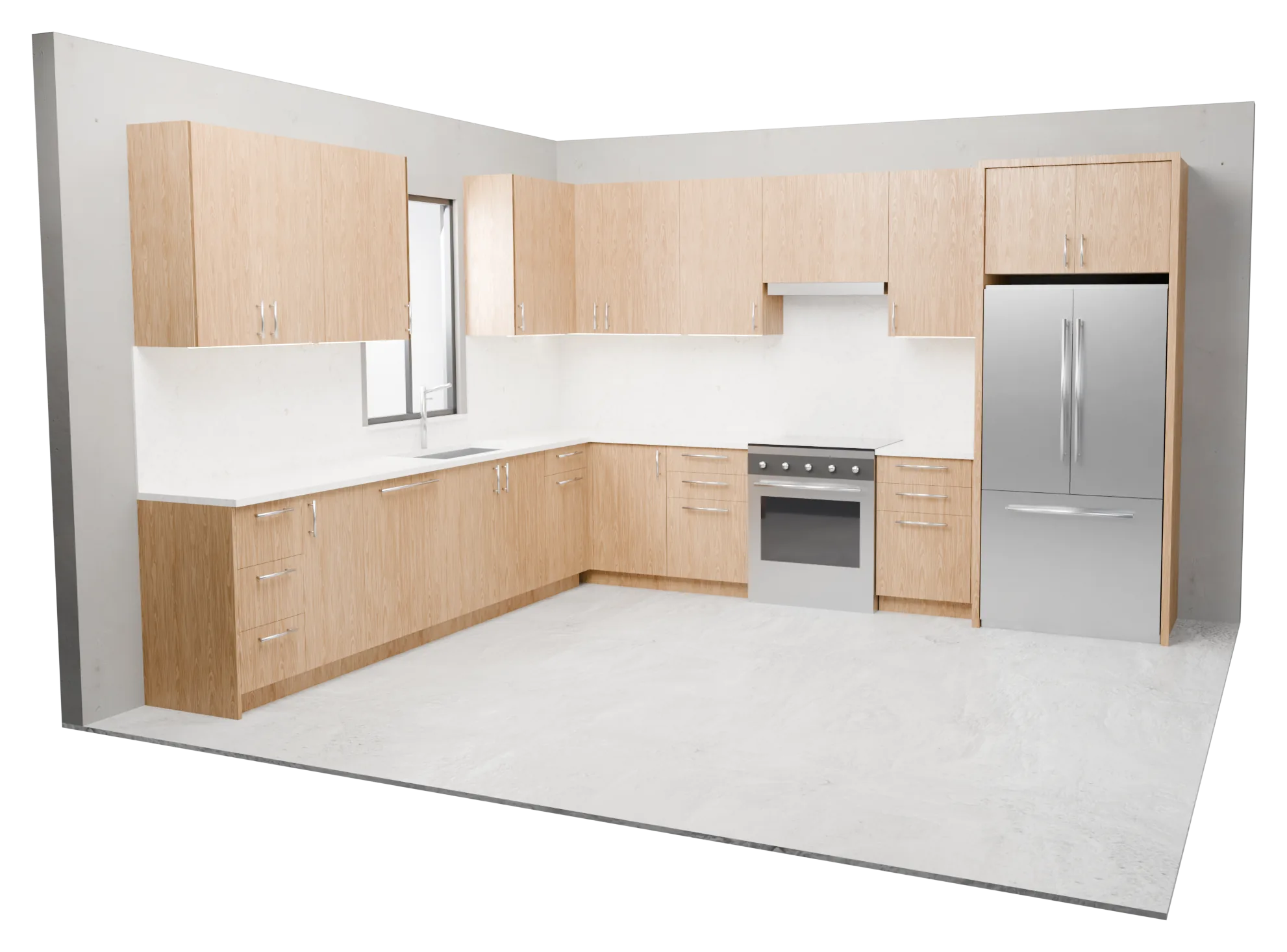
What are cabinet parts and components?
Cabinet parts are the pieces that finish a run rather than store things: fillers that close the gaps to walls and appliances, surrounds and panels that wrap a refrigerator or an exposed end, plinths that carry the cabinets, and shelves and boxes for open walls. Every Sealab part is configured to your width, height and depth within its model’s range.
- Panels and parts in the catalog
- 16 configurable models
- Sizes
- Width, height and depth set per part
- Fillers
- Front-material face, case-material return
- Made
- In the same CNC process as the cabinets
The parts around a refrigerator
A built-in refrigerator uses most of the parts a kitchen needs: a surround, fillers on either side of the cabinets next to it and shelves on the open wall. Here is one, with every part numbered.
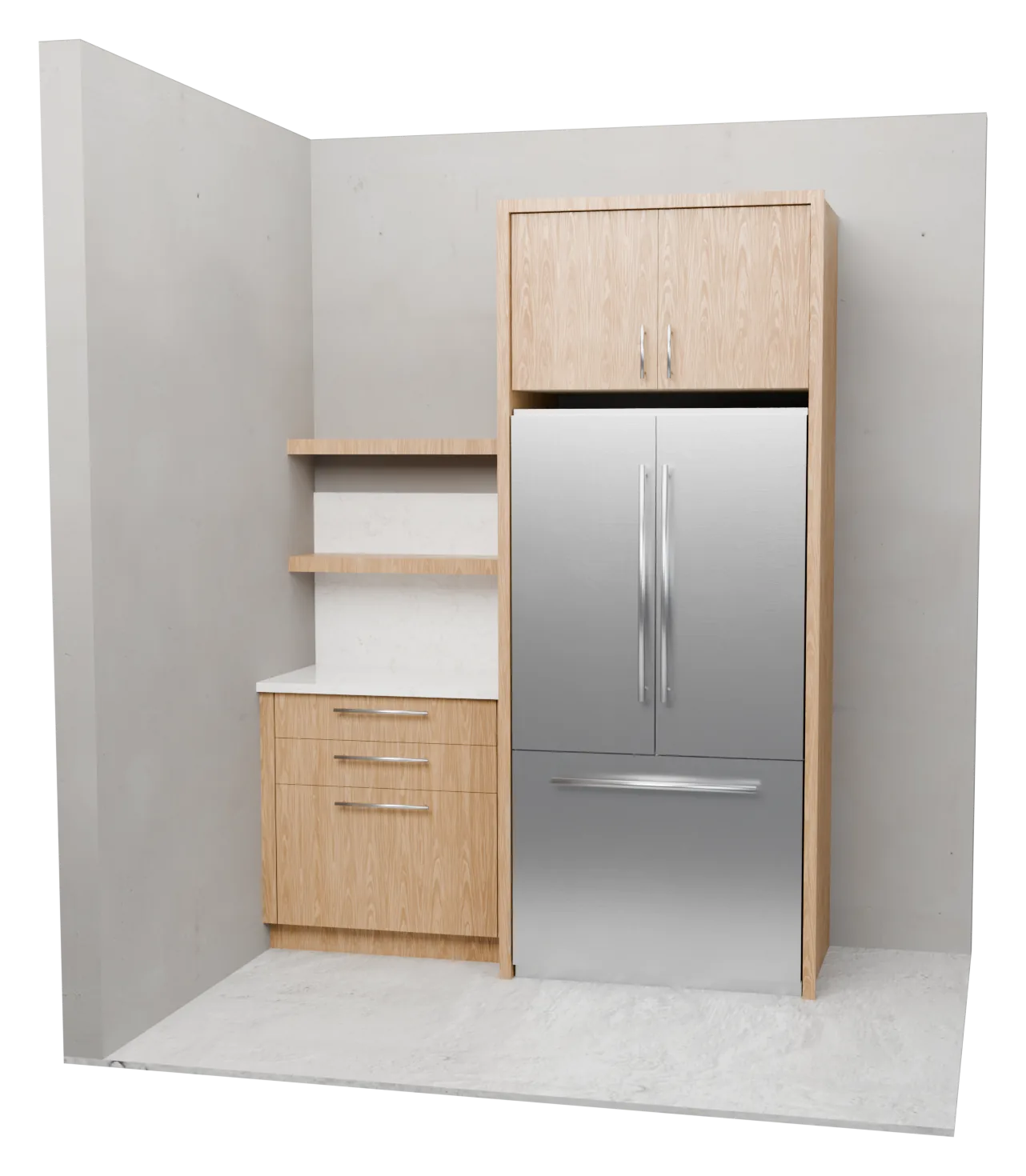
Panels and parts in the catalog
Each model opens its own page, with its sizes and options, where you can configure it.
- Corner filler consisting of two front pieces meeting at the corner, with adjustable corner dimensionsLP_CR_15676 to 48 in wide
- Five-sided hollow decorative assembly with an open undersideLP_DSP5SDE_15903 to 48 in wide
- Six-sided hollow decorative assembly, enclosed on all sidesLP_DSP6SDE_15913 to 48 in wide
- Left filler assembly with a front-material face and a case-material side returnLP_FPL_15771 1/2 to 48 in wide
- Right filler assembly with a front-material face and a case-material side returnLP_FPR_15781 1/2 to 48 in wide
- Four-sided case-material surround with a continuous front lip and mitered visible cornersLP_FR_158510 to 96 in wide
- Four-sided case-material surround with continuous front and back lips and mitered visible cornersLP_FR_158610 to 96 in wide
- Cantilever Floating ShelfLP_FS_157610 to 96 in wide
- Single horizontal case-material panel with optional edgebandingLP_GP_15623 to 96 in wide
- Double miter panel with a front face and mitered returns on both sidesLP_MPD_15751 1/2 to 48 in wide
- Miterpanel (left)LP_MPL_15721 to 48 in wide
- Miterpanel (right)LP_MPR_15731 to 48 in wide
- Simple ladder frame plinthLP_PL_15712 to 96 in wide
- Loose front-only part matching the selected door/drawer-front constructionLP_SP_15662 to 48 in wide
- Three-sided miter-frame surround panel with a programmable lip on the front edge onlyLP_SRP_158410 to 96 in wide
- Three-sided miter-frame surround panel with programmable lips on the front and backLP_SRP_158710 to 96 in wide
How big are fillers, panels and toe kicks?
Typical figures for a kitchen. Sealab parts are made to the size you set, so treat them as a starting point and work from your own walls and appliances.
- Filler at a wall
- 1 1/2 to 3 in 38 to 76 mm
- A usual allowance between the last cabinet and a wall, so doors and drawers open past the wall and the face can be scribed to it.
- Toe kick height
- 4 in 102 mm
- The usual recess under base cabinets, whether they stand on leg levelers or a plinth.
- Panel thickness
- 3/4 in 19 mm
- The thickness of the cabinet sides, so panels and surrounds line up with the cabinets beside them.
- Floating shelf thickness
- 2 in or more 51 mm or more
- Room inside the shelf for the concealed steel supports that carry it.
How to finish a run of cabinets
Plan the parts with the cabinets, not after them: the gaps at walls, appliances and corners decide the cabinet widths too.
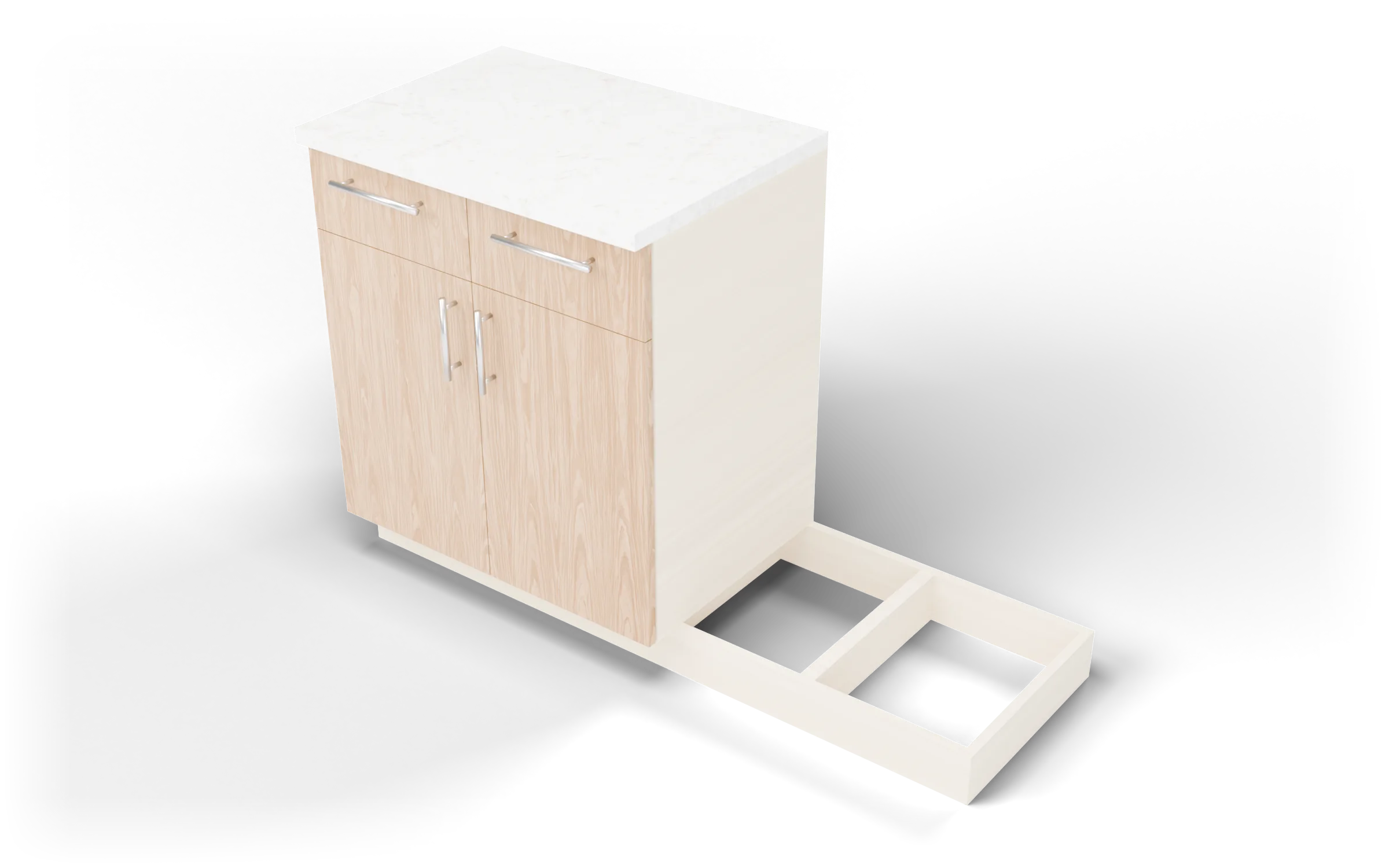
Measure wall to wall and leave room for fillers
Walls are rarely straight or square. Where a run meets a wall, plan a filler so the doors and drawers next to it open freely, and scribe its face to the wall.
Build the refrigerator in
A three-sided surround wraps the sides and top of the refrigerator, with a deep upper above it. Size the opening to the refrigerator’s installation instructions, including the clearance it needs to open and breathe.
Keep drawers clear of the surround
A surround’s front lip runs past its side panel, across the edge of the cabinet beside it. A narrow filler between the two makes room for the lip and lets drawers and handles open past it.
Turn corners with a corner filler
Where two runs meet, a corner filler with two front pieces keeps the doors and handles on each run from hitting the other.
Choose what the run stands on
Each cabinet stands on leg levelers, or a ladder-frame plinth carries several cabinets at once. The toe kick in front is a finish face and supports nothing.
Finish the ends and the open walls
Miter panels give the end of a run or the side of an appliance a mitered edge, and floating shelves and mitered boxes carry things on an open wall.
Fillers, supports and construction
Fillers and surrounds
Fillers have a front-material face with a case-material return behind it. Surrounds are case-material frames with mitered corners and a lip on the front, or on the front and back, that makes the opening slightly smaller.
Panels, fillers and partsSupports and toe kicks
Base cabinets stand on Hafele Axilo leg levelers or on a ladder-frame plywood plinth that spans several of them. A toe kick dresses the front of either one.
The base cabinet guideConstruction
Every part is CNC machined in the same process as the cabinets and supplied ready to assemble, so it lines up with the boxes beside it.
Construction methods
Questions about cabinet parts
What is a cabinet filler?
A filler is a narrow piece that closes the gap between a cabinet and a wall, an appliance or another cabinet, so doors and drawers can open without hitting what is next to them. Sealab fillers have a front-material face that matches the doors and a case-material return behind it.
Do frameless cabinets need fillers?
Usually at walls and corners. Frameless doors cover the edges of the box, so a door or drawer set right against a wall or a corner cannot open fully. A filler moves it far enough away. Between two cabinets in a run, fillers are rarely needed.
What is a refrigerator surround?
A set of finished panels that wraps the sides and top of a refrigerator so it looks built into the cabinetry. A three-sided surround with mitered corners and a front lip frames the opening; a deep upper cabinet usually fills the space above the refrigerator inside it.
Do I need a filler next to a refrigerator?
Often, yes. A surround’s front lip runs past its side panel, so a narrow filler between the surround and the cabinet beside it makes room for the lip and keeps drawers and handles clear. Check your refrigerator’s instructions for the clearance its doors need.
What is a plinth, and do I need one?
A plinth is a ladder frame of plywood that a run of base cabinets stands on, instead of leg levelers under each cabinet. It is an alternative to leg levelers, not a requirement: one frame, leveled once, carries several cabinets.
Does the toe kick hold up the cabinets?
No. The toe kick is a finish face that covers the leg levelers or the plinth. The cabinets stand on the levelers or the plinth behind it.
How is a floating shelf held up?
By concealed steel supports inside the shelf, which is why it is at least 2 inches thick. The supports are not included and must be anchored into the framing behind the finished wall.
Can I order parts on their own?
Yes. Each part is its own model in the catalog, set to the size you need and priced in your cart like a cabinet, so you can add parts to a cabinet order or order them by themselves.
Add the parts to your run
Pick a part, set its width, height and depth, and see the price in your cart. If your run needs something the catalog doesn’t have, send us a sketch.